
Weekly Market Insights – August 1, 2022

Weekly Market Insights – August 1, 2022

Presented by Elsass Financial Group

Undaunted by another Fed rate hike and news of a contracting economy, the stock market rallied last week on better-than-expected corporate earnings.

The Dow Jones Industrial Average increased 2.97%, while the Standard & Poor’s 500 picked up 4.26%. The Nasdaq Composite index gained 4.70% for the week. The MSCI EAFE index, which tracks developed overseas stock markets, rose 0.95%.1,2,3

Stocks Rally on Earnings

It was an inauspicious start to the week after a big-box retailer missed earnings and reduced forward guidance on Tuesday, sparking a broad market retreat.

But sentiment improved following mega-cap technology company earnings that proved better than expected. Enthusiasm gathered steam in the wake of the Fed’s 0.75% rate hike, boosted by Fed Chair Powell’s comments following Wednesday’s Federal Open Market Committee meeting. Powell indicated that it might become appropriate to slow the pace of future hikes, and he didn’t believe the economy had entered into recession. Stocks on Thursday shrugged off news of a second-consecutive quarter of negative economic growth to build on Wednesday’s gains as fresh earnings continued to comfort, if not impress, investors.4

Economy Contracts 

The U.S. economy shrank at an annualized rate of 0.9% in the second quarter as consumers pulled back on spending and businesses worked to reduce inventories. It was the second-consecutive quarter of negative economic growth, meeting the technical definition of a recession. Unlike past recessions, hiring has been strong all year, with the unemployment rate near historic lows.5

The economic slowdown was attributable primarily to decreases in inventories, a deceleration in the housing market, and lower government spending. Consumer spending increased a tepid one percent, well below the inflation rate during the same period.6

This Week: Key Economic Data

Monday: Institute for Supply Management (ISM) Manufacturing Index.

Tuesday: Job Openings and Labor Turnover Survey (JOLTS).

Wednesday: Automated Data Processing (ADP) Employment Report. Institute for Supply Management (ISM) Services Index. Factory Orders.

Thursday: Jobless Claims.

Friday: Employment Situation.

Source: Econoday, July 29, 2022
The Econoday economic calendar lists upcoming U.S. economic data releases (including key economic indicators), Federal Reserve policy meetings, and speaking engagements of Federal Reserve officials. The content is developed from sources believed to be providing accurate information. The forecasts or forward-looking statements are based on assumptions and may not materialize. The forecasts also are subject to revision.

This Week: Companies Reporting Earnings

Tuesday: Advanced Micro Devices, Inc. (AMD), PayPal Holdings, Inc. (PYPL), Caterpillar, Inc. (CAT), Prudential Financial, Inc. (PRU), Starbucks Corporation (SBUX), Marathon Petroleum Corporation (MPC), Marriott International, Inc. (MAR).

Wednesday: CVS Health Corporation (CVS), Fortinet, Inc. (FTNT), PPL Corporation (PPL), Booking Holdings, Inc. (BKNG), Occidental Petroleum Corporation (OXY), Regeneron Pharmaceuticals, Inc. (REGN).

Thursday: Block, Inc. (SQ), Twilio, Inc. (TWLO), Amgen, Inc. (AMGN), Eli Lilly and Company (LLY), ConocoPhillips (COP), Air Products and Chemicals, Inc. (APD), Albemarle Corporation (ALB), Kellogg Company (K).

Friday: Berkshire Hathaway, Inc. (BRK.A).

Source: Zacks, July 29, 2022
Companies mentioned are for informational purposes only. It should not be considered a solicitation for the purchase or sale of the securities. Investing involves risks, and investment decisions should be based on your own goals, time horizon, and tolerance for risk. The return and principal value of investments will fluctuate as market conditions change. When sold, investments may be worth more or less than their original cost. Companies may reschedule when they report earnings without notice.

“Innovation is saying ‘no’ to 1,000 things.”

– Steve Jobs

Don’t Forget to Take Advantage of the Work Opportunity Tax Credit

The work opportunity tax credit is a federal tax credit for business owners that have hired individuals from target groups that would have otherwise faced significant barriers when looking for a job. Some target groups include summer youth employees, those receiving Supplemental Security Income, or qualified long-term unemployment recipients. There are ten targeted groups in total.

The work opportunity tax credit equals 40% of up to $6,000 wages paid or incurred with a maximum credit of $2,400. The WOTC may consider up to $24,000 in wages for certain qualified veteran targeted groups. There are some restrictions on the IRS’ site.

* This information is not intended to be a substitute for specific, individualized tax advice. We suggest that you discuss your specific tax issues with a qualified tax professional.

Tip adapted from IRS.gov7

Stay Safe This Summer With These Open Water Safety Tips 

Summer is the perfect time to spend at the beach, lake, or river. But unfortunately, these natural bodies of water can also be hazardous if you don’t know how to stay safe. Here are some tips to help you and your family stay safe in the water this summer:

  • Only swim in the designated swimming area. Take note of flags and buoys that mark where you can and can’t swim.
  • When in doubt, get out! If something doesn’t feel suitable, such as a current picking up, it’s better to err on the side of caution and get out.
  • Know the conditions before you swim. The more you know about water levels, temperature, and current, the better.
  • Never swim alone when in open water. Always swim with a buddy who can look out for you, and you can look out for them.

Tip adapted from the National Drowning Prevention Alliance8

A rain gauge collects rainfall each day of a wet week beginning on Monday. Every day, the amount of rain in the gauge doubles. At Sunday’s end, the rain gauge is completely filled. So on which day is it half-filled?

Last week’s riddle: I can’t be seen, but I’m all around. I have no mouth, yet can make a sound. I can be harnessed, but never bound. No hands have I, yet I move the ground. What am I?  Riddle answer: Wind.

Village of Hope, Hope Valley, Derbyshire, United Kingdom


Footnotes and Sources


1. The Wall Street Journal, July 29, 2022

2. The Wall Street Journal, July 29, 2022

3. The Wall Street Journal, July 29, 2022

4. The Wall Street Journal, July 27, 2022

5. CNBC, July 28, 2022

6. CNBC, July 28, 2022

7. IRS.gov, May 5, 2022

8. NDPA.org, May 26, 2022

Investing involves risks, and investment decisions should be based on your own goals, time horizon, and tolerance for risk. The return and principal value of investments will fluctuate as market conditions change. When sold, investments may be worth more or less than their original cost.

The forecasts or forward-looking statements are based on assumptions, may not materialize, and are subject to revision without notice.

The market indexes discussed are unmanaged, and generally, considered representative of their respective markets. Index performance is not indicative of the past performance of a particular investment. Indexes do not incur management fees, costs, and expenses. Individuals cannot directly invest in unmanaged indexes. Past performance does not guarantee future results.

The Dow Jones Industrial Average is an unmanaged index that is generally considered representative of large-capitalization companies on the U.S. stock market. Nasdaq Composite is an index of the common stocks and similar securities listed on the NASDAQ stock market and is considered a broad indicator of the performance of technology and growth companies. The MSCI EAFE Index was created by Morgan Stanley Capital International (MSCI) and serves as a benchmark of the performance of major international equity markets, as represented by 21 major MSCI indexes from Europe, Australia, and Southeast Asia. The S&P 500 Composite Index is an unmanaged group of securities that are considered to be representative of the stock market in general.

U.S. Treasury Notes are guaranteed by the federal government as to the timely payment of principal and interest. However, if you sell a Treasury Note prior to maturity, it may be worth more or less than the original price paid. Fixed income investments are subject to various risks including changes in interest rates, credit quality, inflation risk, market valuations, prepayments, corporate events, tax ramifications and other factors.

International investments carry additional risks, which include differences in financial reporting standards, currency exchange rates, political risks unique to a specific country, foreign taxes and regulations, and the potential for illiquid markets. These factors may result in greater share price volatility.

Please consult your financial professional for additional information.

This content is developed from sources believed to be providing accurate information. The information in this material is not intended as tax or legal advice. Please consult legal or tax professionals for specific information regarding your individual situation. This material was developed and produced by FMG Suite to provide information on a topic that may be of interest. FMG is not affiliated with the named representative, financial professional, Registered Investment Advisor, Broker-Dealer, nor state- or SEC-registered investment advisory firm. The opinions expressed and material provided are for general information, and they should not be considered a solicitation for the purchase or sale of any security.

Copyright 2022 FMG Suite.

Copyright © 2026
Elsass Financial Group

Microsoft flags common pitfalls for cyber insurance

Microsoft flags common pitfalls for cyber insurance

Cyber insurance is getting more expensive and tougher to acquire. At RSA Conference 2022, Microsoft’s Cynthia James discussed the common mistakes made when obtaining coverage.

Cynthia James, an enterprise security executive at Microsoft, spoke at RSA Conference 2022 on Monday about what makes cyber insurance so tricky and the best ways for CISOs and others in the field to navigate the complex market.


To open, James acknowledged that even cyber insurance companies may not always have a grasp on what they are doing. She cited a conversation she had in 2017 with a cyber insurance provider that was sponsoring a convention.

“I said, ‘How is it that you guys know how to estimate who is going to get hit, and for how much, when we don’t even know?'” James said. “They said ‘Oh, we don’t know; we just want a piece of that market because we know it’s going to be big.'”

James then mentioned that while the market did explode in recent years, the costs and overall stress on the field increased, too. In 2019, experts said cyber insurance policies were inexpensive and easy to obtain, with minimal underwriting or cybersecurity reviews. James noted that companies used to be able to get $3 million in coverage for $3,000.

“You can’t get anything close to that today,” she said, adding that the price for the same coverage is closer to $300,000 today.

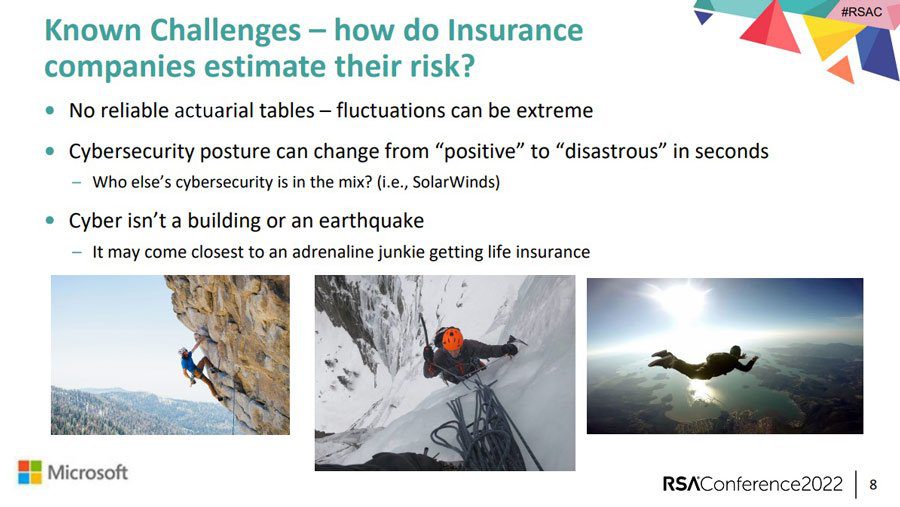
The reasons are simple, James said. There isn’t a lot of actuarial data for insurance carriers to properly assess risk, but there are a lot of cyber attacks, and they’re becoming too costly for the market.

“It’s a big market [worth] $20 billion in 2021, but it has a terrible loss ratio. The way the insurance companies look at it is, for every dollar they bring in for a premium, they want to pay 50 cents or less on a claim,” James said, noting that the ratio for cyber insurance is much higher. “80 cents on every dollar goes out [for cyber claims], which is a huge problem for them.”

MICROSOFT CYBER INSURANCE RSA CONFERENCE 2022

Microsoft’s Cynthia James explained that the cyber insurance market can fluctuate wildly because there isn’t enough actuarial data and because organizations are at great risk of cyber attacks.
 

According to James, the complexity of the plans and the coverage is rising with the prices. She noted that insurance providers will riddle policies with fine print, making the job of an adept CISO who can accurately address the needs of the company even more important.

While around 95% of claims are paid, insurance providers will sometimes waive coverage following an event. James said that the top five reasons insurers don’t pay are:

  1. “It’s related to the same breach as last year.”
  2. “We only pay up to _____ (sublimit).”
  3. “We only pay for costs AFTER you notify us.”
  4. “We gave you negotiators/forensics/media advice you didn’t use.”
  5. “Your depiction of your security posture was inaccurate.”

James also presented the seven biggest pitfalls and errors that she’s seen companies make with cyber insurance.

The first error was not making sure to get more than one bid for a policy and not trying and get as much coverage as possible within the budget allotted. James urged audience members to go to more than one provider and capitalize on any possible cost reductions that are available like better security posture scoring or advancing technology.

The second was not being explicit enough with the coverage and allowing for providers to harp on fine print and technicalities to avoid paying out claims. These can include policy exclusions for cyber acts of war, which have loomed in the wake of Russia’s invasion of Ukraine and the escalating cyber attacks that followed.

The third pitfall was not communicating with the rest of the company about the different trade-offs of each plan and what is best for the company. James said one of the worst things a CISO or someone in a similar position could do is fail to document the suggestions and end up a scapegoat following a breach.

The fourth pitfall was overreporting or underreporting incidents to insurance providers. She recommended that providers be kept in the loop about a company’s security breach and make sure that they are alerted on time. However, she also said that telling too much about a breach could lead to them picking out minor examples of human negligence to void the coverage.

The fifth pitfall was similar to the fourth — oversharing or undersharing when it comes to the state of a company’s security systems. An insurance provider should be made aware of the state of a customer’s cybersecurity posture and any significant updates made, but they do not need to see the underbelly of the infrastructure, James said.

The sixth was that a company should never renew a cyber insurance policy without first revaluating the policy price as well as the threat environment. Throughout her presentation, James hammered home that an active examination of the company’s risk and potential cost is incredibly important for getting proper coverage.

The final pitfall that James mentioned was not ensuring that all critical threats are covered. If a company cannot have full top-down coverage due to its size, she said it is imperative that it examines which systems are at the highest risk and which are the most valuable and make sure that they are insured for all kinds of breaches. She also urged organizations to present specific attack scenarios to their insurance carriers to make sure those types of threats will be covered.

James said that the best way to spend money and obtain affordable coverage by implementing multifactor authentication, phish-testing users, have tested backup systems and encrypt sensitive data, among others. In closing, she urged audience members who have cyber insurance to get a copy of their current policies to review for any pitfalls, errors or shortcomings that need to be addressed.


Copyright © 2026
Elsass Financial Group

Weekly Market Insights – August 1, 2022

Weekly Market Insights – July 25, 2022

Presented by Elsass Financial Group

Stocks rallied last week as investor spirits lifted thanks to a better-than-expected start to the second-quarter earnings season.

The Dow Jones Industrial Average gained 1.95%, while the Standard & Poor’s 500 added 2.55%. The Nasdaq Composite index jumped 3.33% for the week. The MSCI EAFE index, which tracks developed overseas stock markets, advanced 3.54%.1,2,3

Earnings Propel Stocks

Earnings season kicked off last week, with major banks reporting second-quarter results. While their results were mixed, they appeared to indicate that consumers and businesses remained reasonably healthy–a perspective that helped erase some negative sentiment overhanging the market.

As the week progressed, stocks gained momentum as earnings results poured in from different sectors of the economy, showing that businesses were navigating higher inflation and slowing growth better than investors feared. Technology and other gloomier sectors were among the market’s best performers for the week. A few disappointing corporate reports and a weak economic report sent stocks lower to close out a solid week.

Cracks in the Foundation 

Data released last week indicated more trouble in the housing market. The latest monthly homebuilder sentiment survey showed the single largest monthly drop in its 37-year history, except for April 2020. The sentiment report preceded a drop in June housing starts and issued building permits. Housing starts declined for the second month, falling 2.0% and surprising economists who had expected an increase.4,5

Housing weakness made itself known through a 5.4% month-over-month decline in June’s existing home sales, representing the slowest pace since June 2020. Increasing prices and higher mortgage rates demonstrated drags on buyer demand.6

This Week: Key Economic Data

Tuesday: New Home Sales.

Wednesday: FOMC Announcement. Durable Goods Orders.

Thursday: Gross Domestic Product (GDP). Jobless Claims.

Source: Econoday, July 22, 2022
The Econoday economic calendar lists upcoming U.S. economic data releases (including key economic indicators), Federal Reserve policy meetings, and speaking engagements of Federal Reserve officials. The content is developed from sources believed to be providing accurate information. The forecasts or forward-looking statements are based on assumptions and may not materialize. The forecasts also are subject to revision.

This Week: Companies Reporting Earnings

Tuesday: Microsoft Corporation (MSFT), General Electric Company (GE), Visa, Inc. (V), Alphabet, Inc. (GOOGL), General Motors Company (GM), The Coca Cola Company (KO), McDonald’s Corporation (MCD), Archer Daniels Midland Company (ADM), 3M Company (MMM), Texas Instruments, Inc. (TXN), United Parcel Service, Inc. (UPS), KimberlyClark Corporation (KMB).

Wednesday: The Boeing Company (BA), Ford Motor Company (F), Qualcomm, Inc. (QCOM), Bristol Myers Squibb Company (BMY), Lam Research Corporation (LRCX), Shopify, Inc. (SHOP), ServiceNow, Inc. (NOW), General Dynamics Corporation (GD), Norfolk Southern Corporation (NSC).

Thursday: Apple, Inc. (AAPL), Intel Corporation (INTC), Mastercard, Inc. (MA), Pfizer, Inc. (PFE), Merck & Co., Inc. (MRK), The Southern Company (SO), Northrop Grumman Corporation (NOC), Southwest Airlines (LUV).

Friday: AbbVie, Inc. (ABBV), Exxon Mobil Corporation (XOM), Chevron Corporation (CVX), The Procter & Gamble Company (PG), ColgatePalmolive Company (CL).

Source: Zacks, July 22, 2022
Companies mentioned are for informational purposes only. It should not be considered a solicitation for the purchase or sale of the securities. Investing involves risks, and investment decisions should be based on your own goals, time horizon, and tolerance for risk. The return and principal value of investments will fluctuate as market conditions change. When sold, investments may be worth more or less than their original cost. Companies may reschedule when they report earnings without notice.

“Lots of people want to ride with you in the limo, but what you want is someone who will take the bus with you when the limo breaks down.”

– Oprah Winfrey

Not All Third-Party Payroll Service Providers Are Equal

Many business owners do the necessary due diligence when hiring a company to handle payroll and payroll tax. But not all choices are the same. A business needs to pick this service wisely because it could fall out of the IRS guidelines if they don’t.

To avoid missed deposits for employment taxes and other important bills, here are some choices to help ensure business owners have a trusted payroll service:

  • Use a certified professional employer organization.
  • Use a reporting agent.
  • Enroll in the Electronic Federal Tax Payment System (EFTPS) to ensure your payroll service providers use EFTPS to max tax deposits. This free platform gives employers quick access to their payment history for deposits under their EIN.

* This information is not intended to be a substitute for specific, individualized tax advice. We suggest that you discuss your specific tax issues with a qualified tax professional.

Tip adapted from IRS.gov7

Celebrate Summer With This Fresh Salad 

The weather is heating up, so cool down with this tasty, healthy, fresh watermelon salad!

Ingredients

  • 5 cups of cubed watermelon
  • 1 cup of diced cucumber
  • ¼ cup thinly sliced red onions
  • ⅓ cup crumbled feta cheese
  • 1 avocado, cubed
  • ⅓ cup torn mint or basil leaves
  • Sea salt

For the dressing

  • 2 tablespoons extra-virgin olive oil
  • 3 tablespoons lime juice
  • ½ garlic clove, minced
  • ¼ teaspoon sea salt

Whisk together all the dressing ingredients in a small bowl and set aside. Arrange the watermelon, cucumber, and red onions and drizzle with half the dressing. Then, add the feta, avocado, and mint. Drizzle with the rest of the dressing. Salt to taste and serve.

Tip adapted from Love and Lemons8

I can’t be seen, but I’m all around. I have no mouth, yet can make a sound. I can be harnessed, but never bound. No hands have I, yet I move the ground. What am I?

Last week’s riddle: You have 9 seemingly identical cubes before you. You are told that one is heavier than the other eight. Using a two-pan balance scale only twice, how can you pick out the heaviest cube?  Riddle answer: Divide the 9 cubes into 3 groups of 3. Weigh two groups. This way, you can find out which group has the heavier cube in it. Choose 2 cubes from this group and compare their weights. By deduction, you will determine the heaviest cube.

Tre Cime Di Lavaredo, Sexten Dolomites, Italy

Footnotes and Sources


1. The Wall Street Journal, July 22, 2022

2. The Wall Street Journal, July 22, 2022

3. The Wall Street Journal, July 22, 2022

4. CNBC, July 18, 2022

5. The Wall Street Journal, July 19, 2022

6. CNBC, July 20, 2022

7. IRS.gov, May 11, 2022

8. Love and Lemons, May 26, 2022

Investing involves risks, and investment decisions should be based on your own goals, time horizon, and tolerance for risk. The return and principal value of investments will fluctuate as market conditions change. When sold, investments may be worth more or less than their original cost.

The forecasts or forward-looking statements are based on assumptions, may not materialize, and are subject to revision without notice.

The market indexes discussed are unmanaged, and generally, considered representative of their respective markets. Index performance is not indicative of the past performance of a particular investment. Indexes do not incur management fees, costs, and expenses. Individuals cannot directly invest in unmanaged indexes. Past performance does not guarantee future results.

The Dow Jones Industrial Average is an unmanaged index that is generally considered representative of large-capitalization companies on the U.S. stock market. Nasdaq Composite is an index of the common stocks and similar securities listed on the NASDAQ stock market and is considered a broad indicator of the performance of technology and growth companies. The MSCI EAFE Index was created by Morgan Stanley Capital International (MSCI) and serves as a benchmark of the performance of major international equity markets, as represented by 21 major MSCI indexes from Europe, Australia, and Southeast Asia. The S&P 500 Composite Index is an unmanaged group of securities that are considered to be representative of the stock market in general.

U.S. Treasury Notes are guaranteed by the federal government as to the timely payment of principal and interest. However, if you sell a Treasury Note prior to maturity, it may be worth more or less than the original price paid. Fixed income investments are subject to various risks including changes in interest rates, credit quality, inflation risk, market valuations, prepayments, corporate events, tax ramifications and other factors.

International investments carry additional risks, which include differences in financial reporting standards, currency exchange rates, political risks unique to a specific country, foreign taxes and regulations, and the potential for illiquid markets. These factors may result in greater share price volatility.

Please consult your financial professional for additional information.

This content is developed from sources believed to be providing accurate information. The information in this material is not intended as tax or legal advice. Please consult legal or tax professionals for specific information regarding your individual situation. This material was developed and produced by FMG Suite to provide information on a topic that may be of interest. FMG is not affiliated with the named representative, financial professional, Registered Investment Advisor, Broker-Dealer, nor state- or SEC-registered investment advisory firm. The opinions expressed and material provided are for general information, and they should not be considered a solicitation for the purchase or sale of any security.

Copyright 2022 FMG Suite.

Copyright © 2026
Elsass Financial Group

3 Tips for the Second Half of 2022

With half the year behind us, now is a great time to consider what the remainder of 2022 may hold. However, with inflation and economic uncertainty causing many of us to delay or cancel vacations, large purchases, and more, it can be challenging to know where to start.

Here are a few tips to help make the rest of the year as smooth as possible:

  • Deflate Inflation – Travel-related costs have skyrocketed, causing many to delay or cancel vacation plans. But are you overreacting to current headlines? Let’s talk if you’re wavering on a scheduled trip.
  • Embrace Uncertainty – If you’ve delayed a major purchase lately, you’re not alone. Economic uncertainty has caused many to rethink their expenditures. When your net worth declines, the “wealth effect” tells consumers to rein in spending. But our portfolio strategy takes into account periods of market volatility.
  • Practice Patience – The need to take action can push even the most seasoned investors into questionable territory. Instead, try to take a long view of the markets. Remaining patient and taking a break from watching the markets closely may help weather the storm.

Let us know if you ever want to chat about your future goals or current economic conditions. We’re always ready to help.

Copyright © 2026
Elsass Financial Group

Weekly Market Insight – July 18, 2022

Weekly Market Insight – July 18, 2022

Presented by Elsass Financial Group

A record-high inflation report, the prospects of a more aggressive Fed, and growing recession fears sent stocks lower– though losses were pared by a Friday rally.

The Dow Jones Industrial Average slipped 0.16%, while the Standard & Poor’s 500 lost 0.93%. The Nasdaq Composite index dropped 1.57% for the week. The MSCI EAFE index, which tracks developed overseas stock markets, lost 3.49%. 1,2,3

Stocks Slide

As the week opened, recession fears intensified with reports of renewed Covid-related lockdowns in China. Also, the U.S. dollar continued to climb, reflecting global economic weakness.

June’s consumer price index report showed price increases accelerating. Year-over-year prices jumped 9.1%, the fastest pace in over 40 years. Speculation grew that the Federal Reserve might contemplate a 100 basis point increase in short-term rates later this month, rather than the 75 basis point hike it earlier signaled. The market rebounded on Friday following comments by an Federal Open Market Committee member who said he favoring a 75 basis point hike. Also helping the Friday rally was a strong retail sales report and additional second-quarter company reports.4

Dollar Strength

The increasing strength of the U.S. dollar moved to center stage last week as the dollar index (a measure of the U.S. dollar to six other major currencies) reached a fresh high, while the euro fell to parity with the dollar and to its lowest level since 2002. 5

A rising U.S dollar hurts overseas profits when converted into dollars and it also makes U.S. products and services more expensive. It’s a challenge for large, multinational companies that derive a portion of their earnings from overseas markets. Greater insight into the extent of that impact may be gained as companies provide forward guidance with their upcoming reports.

This Week: Key Economic Data

Tuesday: Housing Starts.

Wednesday: Existing Home Sales.

Thursday: Jobless Claims. Index of Leading Economic Indicators. 

Friday: Purchasing Managers’ Index (PMI) Composite Flash.

Source: Econoday, July 15, 2022
The Econoday economic calendar lists upcoming U.S. economic data releases (including key economic indicators), Federal Reserve policy meetings, and speaking engagements of Federal Reserve officials. The content is developed from sources believed to be providing accurate information. The forecasts or forward-looking statements are based on assumptions and may not materialize. The forecasts also are subject to revision.

This Week: Companies Reporting Earnings

Monday: Bank of America (BAC), International Business Machines (IBM), The Goldman Sachs Group (GS), The Charles Schwab Corporation (SCHW)

Tuesday: Netflix, Inc. (NFLX), Johnson & Johnson (JNJ), J.B. Hunt Transport Services, Inc. (JBHT)

Wednesday: Tesla, Inc. (TSLA), Abbott Laboratories (ABT), CSX Corporation (CSX), United Airlines Holdings, Inc. (UAL)

Thursday: AT&T, Inc. (T), Snap, Inc. (SNAP), Blackstone, Inc. (BX), American Airlines Group, Inc. (AAL), Union Pacific Corporation (UNP), D.R. Horton, Inc. (DHI)

Friday: Verizon Communications, Inc. (VZ), Schlumberger Limited (SLB), American Express Company (AXP), NextEra Energy, Inc. (NEE), PPG Industries, Inc. (PPG)

Source: Zacks, July 15, 2022
Companies mentioned are for informational purposes only. It should not be considered a solicitation for the purchase or sale of the securities. Investing involves risks, and investment decisions should be based on your own goals, time horizon, and tolerance for risk. The return and principal value of investments will fluctuate as market conditions change. When sold, investments may be worth more or less than their original cost. Companies may reschedule when they report earnings without notice.

“When you come to the end of your rope, tie a knot and hang on.”

– Franklin Delano Roosevelt

Recovering Documents Following a Natural Disaster

If you live in an area that’s prone to natural disasters, it’s important to be prepared by knowing how to manage your important documents and paperwork, and by knowing what to do if those materials are lost. Here are some tips from the IRS:

  • Contact the IRS or go online and search their database for help in reconstructing records after a natural disaster or casualty loss.
  • Download Publication 584, Casualty, Disaster, and Theft Loss Workbook to figure out your loss on business and income-producing properties in the event of a natural disaster.
  • Read Publication 3067, IRS Disaster Assistance – Federally Declared Disaster for information about how federally declared disasters affect individuals and business owners. This document also covers the assistance available to victims.

* This information is not intended to be a substitute for specific, individualized tax advice. We suggest that you discuss your specific tax issues with a qualified tax professional.

Tip adapted from IRS.gov6

Everything You Need to Know About Walking Meditation

You’ve likely heard about sitting meditation, where you’re encouraged to find a comfortable place to sit or lay down, but have you ever heard of walking meditation?

Walking meditation follows similar principles to sitting or lying meditation, but instead of staying in the same place, you direct your focus to your footsteps and the experience of walking. The goal is to be mindful of every step and experience something that we usually do automatically. You can focus on the mechanics of each step, your breathing, or the sights and smells on your walk. And you don’t have to walk far to enjoy the benefits! A quick, 10-minute walk will leave you more focused, mindful, and centered. 

Tip adapted from Greater Good in Action at Berkeley7

You have 9 seemingly identical cubes before you. You are told that one is heavier than the other eight. Using a two-pan balance scale only twice, how can you pick out the heaviest cube?

Last week’s riddle: Two in every corner, one in every room, none in a house. What is it? Riddle answer: The letter “R.”

Licancabur Volcano, Atacama desert, Chile
 

Footnotes and Sources


1. The Wall Street Journal, July 15, 2022

2. The Wall Street Journal, July 15, 2022

3. The Wall Street Journal, July 15, 2022

4. The Wall Street Journal, July 13, 2022

5. CNBC, July 11, 2022

6. IRS.gov, May 16, 2022

7. Berkeley.edu, May 26, 2022

Investing involves risks, and investment decisions should be based on your own goals, time horizon, and tolerance for risk. The return and principal value of investments will fluctuate as market conditions change. When sold, investments may be worth more or less than their original cost.

The forecasts or forward-looking statements are based on assumptions, may not materialize, and are subject to revision without notice.

The market indexes discussed are unmanaged, and generally, considered representative of their respective markets. Index performance is not indicative of the past performance of a particular investment. Indexes do not incur management fees, costs, and expenses. Individuals cannot directly invest in unmanaged indexes. Past performance does not guarantee future results.

The Dow Jones Industrial Average is an unmanaged index that is generally considered representative of large-capitalization companies on the U.S. stock market. Nasdaq Composite is an index of the common stocks and similar securities listed on the NASDAQ stock market and is considered a broad indicator of the performance of technology and growth companies. The MSCI EAFE Index was created by Morgan Stanley Capital International (MSCI) and serves as a benchmark of the performance of major international equity markets, as represented by 21 major MSCI indexes from Europe, Australia, and Southeast Asia. The S&P 500 Composite Index is an unmanaged group of securities that are considered to be representative of the stock market in general.

U.S. Treasury Notes are guaranteed by the federal government as to the timely payment of principal and interest. However, if you sell a Treasury Note prior to maturity, it may be worth more or less than the original price paid. Fixed income investments are subject to various risks including changes in interest rates, credit quality, inflation risk, market valuations, prepayments, corporate events, tax ramifications and other factors.

International investments carry additional risks, which include differences in financial reporting standards, currency exchange rates, political risks unique to a specific country, foreign taxes and regulations, and the potential for illiquid markets. These factors may result in greater share price volatility.

Please consult your financial professional for additional information.

This content is developed from sources believed to be providing accurate information. The information in this material is not intended as tax or legal advice. Please consult legal or tax professionals for specific information regarding your individual situation. This material was developed and produced by FMG Suite to provide information on a topic that may be of interest. FMG is not affiliated with the named representative, financial professional, Registered Investment Advisor, Broker-Dealer, nor state- or SEC-registered investment advisory firm. The opinions expressed and material provided are for general information, and they should not be considered a solicitation for the purchase or sale of any security.

Copyright 2022 FMG Suite.

Copyright © 2026
Elsass Financial Group

3 Shrewd Maneuvers in a Down Market

It’s natural to think “defense” during a bearish market season. But why not mix in some “offense” with your defense? Here are three moves we can discuss together that may be helpful during the current market downturn.

  1. Invest Your Excess Cash: If you have excess cash earmarked for a long-term goal (retirement or college, for example), a downturn may present an opportunity. Over the last three years, the Standard & Poor’s 500 compounded annual growth rate was 9%. Even with all the pandemic-related volatility, that’s still shy of its historical average.1


  2. Consider Series I Savings Bonds: With inflation at 40-year highs, you might consider some fresh ideas for investing. I Bonds pay a rate of return plus inflation protection and are backed by the U.S. government. You can visit TreasuryDirect.gov to open a free account (as always, reach out if you have any questions).
  3. Take a Look at Taxes: Each year, taxpayers can deduct up to $3,000 in realized losses. If your losses exceed $3,000, you may be able to carry them forward into future years. Make sure to speak with your tax professional before making any decisions.

I’m confident we’ll see a brighter economic picture before too long. In the meantime, it’s a shrewd move to find ways to better your position, and I’m always available to help you think it through.

1. Yahoo Finance showed the S&P 500 at 3020.97 on June 24, 2019, and 3,911.74 on June 24, 2022. Past performance does not guarantee future results, individuals can’t invest directly in an index, and the return and principal value of stock prices will fluctuate.
Copyright © 2026
Elsass Financial Group