
Weekly Market Insight – October 10, 2022

Presented by Elsass Financial Group

A powerful two-day stock rebound cemented a positive week for investors as a new trading month began.

The Dow Jones Industrial Average rose 1.99%, while the Standard & Poor’s 500 added 1.51%. The Nasdaq Composite index increased 0.73% for the week. The MSCI EAFE index, which tracks developed overseas stock markets, gained 3.42%.1,2,3

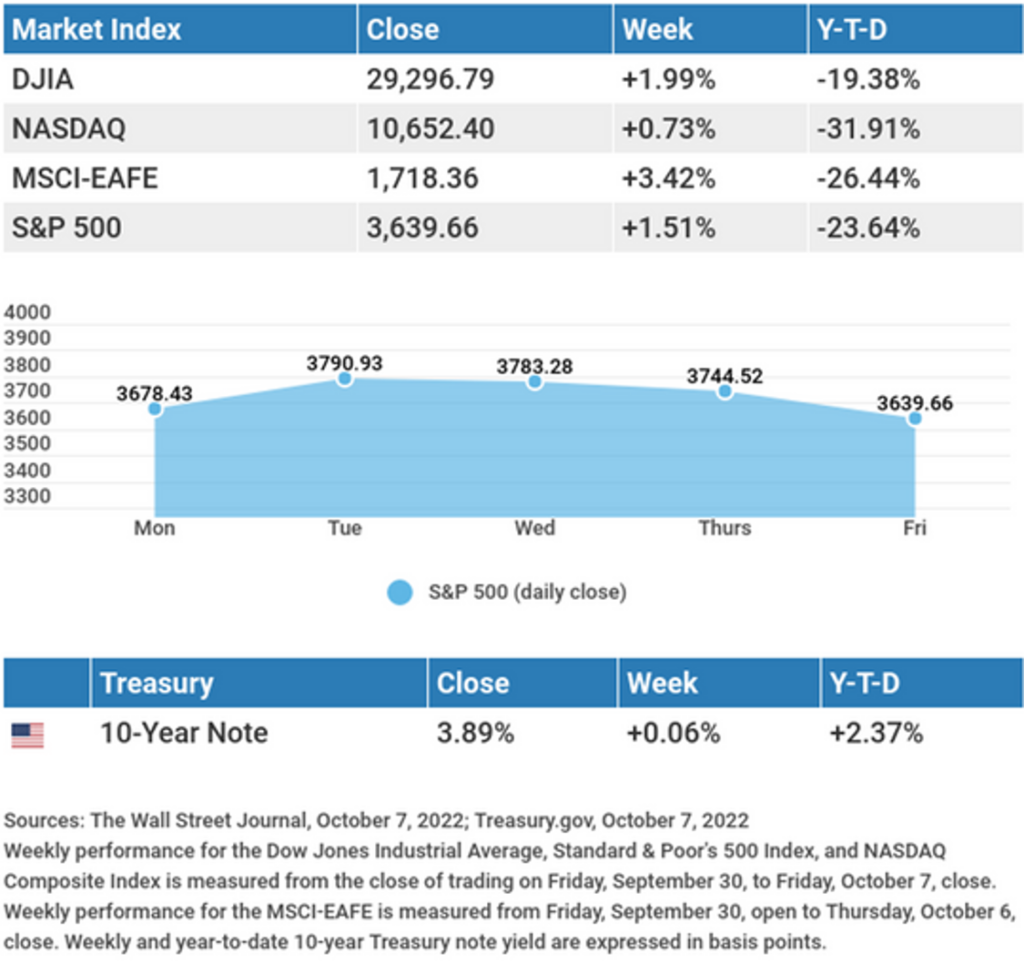
Stocks Start Strongly

Stocks opened the week posting their best two-day rally since March 2020, as the U.K. prime minister’s decision to reverse a tax cut proposal that had upended financial markets the previous week lifted investors.4

Falling yields further lifted investor enthusiasm, as did new economic data indicating a cooling economy. Losses in the last two days erased much of the gains as concerns about higher rates and recession once again moved front and center. The selling pressure was due to a stream of hawkish comments by Fed officials and labor market data that suggested the Fed would likely stick with its rate-hike plans.

A Mixed Labor Picture

Employment-related reports offered conflicting signals on the state of the labor market. In a sign of cooling, the number of open jobs in August fell 10%, while a subsequent report from Automated Data Processing (ADP) showed continued labor market strength. ADP reported private employers added a higher-than-anticipated 208,000 jobs in September, and annual wages rose 7.8% from a year ago.5,6

Jobless claims rose to 219,000, up from the previous week’s 190,000 and in line with 2019’s average. September’s employment report showed that employers added 263,000 jobs–slightly lower than expectations. The combination of new hiring and lower labor force participation led to a drop in the unemployment rate to 3.5%.7,8

This Week: Key Economic Data

Wednesday: Producer Price Index (PPI). Federal Open Market Committee (FOMC) Meeting Minutes.

Thursday: Consumer Price Index (CPI). Jobless Claims.

Friday: Retail Sales.

Source: Econoday, October 7, 2022

The Econoday economic calendar lists upcoming U.S. economic data releases (including key economic indicators), Federal Reserve policy meetings, and speaking engagements of Federal Reserve officials. The content is developed from sources believed to be providing accurate information. The forecasts or forward-looking statements are based on assumptions and may not materialize. The forecasts also are subject to revision.

This Week: Companies Reporting Earnings

Wednesday: Delta Air Lines, Inc. (DAL), PepsiCo, Inc. (PEP).

Thursday: Wells Fargo & Company (WFC), Walgreens Boots Alliance, Inc. (WBA), BlackRock, Inc. (BLK).

Friday: JPMorgan Chase & Co. (JPM), UnitedHealth Group, Inc. (UNH), Citigroup, Inc. (C), Morgan Stanley (MS), The PNC Financial Services Group, Inc. (PNC), U.S. Bancorp (USB).

Source: Zacks, October 7, 2022

Companies mentioned are for informational purposes only. It should not be considered a solicitation for the purchase or sale of the securities. Investing involves risks, and investment decisions should be based on your own goals, time horizon, and tolerance for risk. The return and principal value of investments will fluctuate as market conditions change. When sold, investments may be worth more or less than their original cost. Companies may reschedule when they report earnings without notice.

“All of us have to learn how to invent our lives, make them up, imagine them. We need to be taught these skills; we need guides to show us how. If we don’t, our lives get made up for us by other people.”

– Ursula K. Le Guin

Essential Tax Reminders for People Selling a Home

If you’re selling your home, you may be able to exclude all or part of any gain from the sale when filing your tax return. To see if you are eligible for this benefit, you have to consider:

The home’s ownership and use: Over five years, ending on the date of the sale, the homeowner must have owned the house and lived in it as their main home for at least two years.

Any gains: Taxpayers who sell their primary home and gain from the sale may be able to exclude up to $250,000 of that gain from their income. The exclusion increases to $500,000 for a married couple filing jointly.

Mortgage debt: Generally, if your mortgage debt was forgiven or canceled, such as in the case of a foreclosure, you have to report this forgiven debt as income on your tax return.

* This information is not intended to be a substitute for specific individualized tax advice. We suggest that you discuss your specific tax issues with a qualified tax professional.

Tip adapted from IRS.gov9

What is Percussive Therapy?

If you’ve ever had a hard workout or gone on a long hike, you know how tight your muscles can get. There are many ways to help alleviate this soreness, from foam rolling to stretching. Percussive therapy is another option to help soothe sore muscles.

Percussive therapy uses a massage gun that rapidly strikes the sore muscle with varying pressure. Percussive therapy devices include names like Theragun, Hypervolt, and a handful of others.

This therapy aims to increase blood flow to the sore muscles to speed up recovery and limit soreness. It is the same idea as deep tissue massages; you glide a percussive massage gun device over sore muscles. Different guns come with various attachments and levels of pressure.

Tip adapted from Greatist10

A man leaves home and makes three left turns. He comes home again and sees two masked men waiting for him, but he jogs straight toward them with a smile as others cheer. Why is this man so unafraid?

Last week’s riddle: Seven people stand in a square room which measures 30′ x 30′. Each one can see the entire room and everyone in it without making any physical movement (aside from eye movement).

Where inside this room can you place an apple so that all but one person can see it? Answer: Place the apple atop one person’s head.


Crater Lake, Crater Lake National Park, Oregon.

Footnotes and Sources

  1. The Wall Street Journal, October 7, 2022
  2. The Wall Street Journal, October 7, 2022
  3. The Wall Street Journal, October 7, 2022
  4. CNBC, October 3, 2022
  5. The Wall Street Journal, October 4, 2022
  6. CNBC, October 5, 2022
  7. The Wall Street Journal, October 6, 2022
  8. CNBC, October 7, 2022
  9. IRS.gov, May 19, 2022
  10. Greatist.com, May 26, 2022

Investing involves risks, and investment decisions should be based on your own goals, time horizon, and tolerance for risk. The return and principal value of investments will fluctuate as market conditions change. When sold, investments may be worth more or less than their original cost.

The forecasts or forward-looking statements are based on assumptions, may not materialize, and are subject to revision without notice.

The market indexes discussed are unmanaged, and generally, considered representative of their respective markets. Index performance is not indicative of the past performance of a particular investment. Indexes do not incur management fees, costs, and expenses. Individuals cannot directly invest in unmanaged indexes. Past performance does not guarantee future results.

The Dow Jones Industrial Average is an unmanaged index that is generally considered representative of large-capitalization companies on the U.S. stock market. Nasdaq Composite is an index of the common stocks and similar securities listed on the NASDAQ stock market and is considered a broad indicator of the performance of technology and growth companies. The MSCI EAFE Index was created by Morgan Stanley Capital International (MSCI) and serves as a benchmark of the performance of major international equity markets, as represented by 21 major MSCI indexes from Europe, Australia, and Southeast Asia. The S&P 500 Composite Index is an unmanaged group of securities that are considered to be representative of the stock market in general.

U.S. Treasury Notes are guaranteed by the federal government as to the timely payment of principal and interest. However, if you sell a Treasury Note prior to maturity, it may be worth more or less than the original price paid. Fixed income investments are subject to various risks including changes in interest rates, credit quality, inflation risk, market valuations, prepayments, corporate events, tax ramifications and other factors.

International investments carry additional risks, which include differences in financial reporting standards, currency exchange rates, political risks unique to a specific country, foreign taxes and regulations, and the potential for illiquid markets. These factors may result in greater share price volatility.

Please consult your financial professional for additional information.

This content is developed from sources believed to be providing accurate information. The information in this material is not intended as tax or legal advice. Please consult legal or tax professionals for specific information regarding your individual situation.

This material was developed and produced by FMG Suite to provide information on a topic that may be of interest. FMG is not affiliated with the named representative, financial professional, Registered Investment Advisor, Broker-Dealer, nor state- or SEC-registered investment advisory firm. The opinions expressed and material provided are for general information, and they should not be considered a solicitation for the purchase or sale of any security.

Copyright 2022 FMG Suite.

Copyright © 2026
Elsass Financial Group

Fed’s Mester sees benchmark rate above 4% and no cuts at least through 2023

Fed’s Mester sees benchmark rate above 4% and no cuts at least through 2023

Cleveland Federal Reserve President Loretta Mester said Wednesday she sees benchmark interest rates rising above 4% by early next year.. CNBC explains these projections: Learn more

OG
Copyright © 2026
Elsass Financial Group

Weekly Market Insight – October 3, 2022

Weekly Market Insight – October 3, 2022

Presented by Elsass Financial Group

Rising recession fears and uncertainty in the bond and currency markets sent stocks to new 2022 lows last week.

The Dow Jones Industrial Average declined 2.92%, while the Standard & Poor’s 500 slumped 2.91%. The Nasdaq Composite index fell 2.69%. The MSCI EAFE index, which tracks developed overseas stock markets, lost 1.94%.1,2,3

A Tumultuous Week

U.S. stocks were under pressure all week due to recession concerns and unsettled trading in the bond and currency markets. This stress followed economic steps out of the U.K. During the previous week, the Bank of England (BOE) raised interest rates, and its prime minister announced unfunded tax cuts that the markets interpreted as inflationary.

U.S. bond yields rose early last week, sending stocks lower until Wednesday’s rally following news that the BOE would buy U.K. government bonds. U.S. stocks resumed their descent the following two days to close out a disappointing week, month, and third quarter.

The Bank Of England Acts

Global bond and currency markets have been volatile recently due to global central bankers raising interest rates to combat inflation. Developments in the U.K. took center stage last week when the BOE announced it would be buying long-dated U.K. government bonds. Upending the financial markets was the previous week’s announcement of tax cuts by the country’s new prime minister, a step many investors viewed as counterproductive to the BOE’s inflation-fighting efforts.

The BOE’s decision to begin temporary purchases of government bonds was well-received by capital markets, sending U.K. bond yields lower and boosting U.K. stock prices in the immediate aftermath.

This Week: Key Economic Data

Monday: Institute for Supply Management (ISM) Manufacturing Index.

Tuesday: Factory Orders. Job Openings and Labor Turnover Survey (JOLTS).

Wednesday: Automated Data Processing (ADP) Employment Report. Institute for Supply Management (ISM) Services Index.

Thursday: Jobless Claims.

Friday: Employment Situation.

Source: Econoday, September 30, 2022
The Econoday economic calendar lists upcoming U.S. economic data releases (including key economic indicators), Federal Reserve policy meetings, and speaking engagements of Federal Reserve officials. The content is developed from sources believed to be providing accurate information. The forecasts or forward-looking statements are based on assumptions and may not materialize. The forecasts also are subject to revision.

This Week: Companies Reporting Earnings

Wednesday: Lamb Weston (LW).

Thursday: Constellation Brands, Inc. (STZ), McCormick & Company, Inc. (MKC), Conagra Brands (CAG).

Source: Zacks, September 30, 2022
Companies mentioned are for informational purposes only. It should not be considered a solicitation for the purchase or sale of the securities. Investing involves risks, and investment decisions should be based on your own goals, time horizon, and tolerance for risk. The return and principal value of investments will fluctuate as market conditions change. When sold, investments may be worth more or less than their original cost. Companies may reschedule when they report earnings without notice.

“The trust of the innocent is the liar’s most useful tool.”

– Stephen King

With Shared Custody, Taxes Can Get Complicated

If you have a legal agreement with your child’s other parent regarding custody, you likely have questions about claiming the child on your tax return and what credits (if any) for which you are eligible.

It may help if you research the Child Tax Credit as well. The parent who claimed the Child Tax Credit for a qualifying child the previous year may have received the advance child tax credit payments the following year. That means that “an eligible parent who did not receive advance payments for a qualifying child will be able to claim the full amount of the child tax credit for that child on a 2022 tax return even if the other parent received advance child tax credit payments.”

* This information is not intended to be a substitute for specific individualized tax advice. We suggest that you discuss your specific tax issues with a qualified tax professional.

Tip adapted from IRS.gov4

Sneak In More Veggies With Mashed Cauliflower

Mashed potatoes are a classic side at any meal, but they can be calorie-dense and don’t provide as much nutritional benefit as other veggies. If you want a tasty and easy way to incorporate more veggies into your meals this year, try this simple mashed cauliflower recipe:

Ingredients

  • 1 head of cauliflower
  • 1 tbsp olive oil
  • 2 garlic cloves (minced)
  • 1-2 tsp of finely chopped herbs such as thyme, rosemary, sage, chives, etc.

Instructions

  1. Trim the leaves off the cauliflower and cut the florets into smaller pieces. Rinse well.
  2. Steam the cauliflower florets in a pot with a steamer insert for about 6-8 minutes.
  3. While the cauliflower is steaming, heat the olive oil in a small pan over medium heat and add the minced garlic and cook until fragrant (about 30 seconds).
  4. Dump out the water from the pot and add the cauliflower, olive oil, garlic, and chopped herbs.
  5. Use a potato masher to mash the cauliflower and combine everything.

Tip adapted from Downshiftology5

Seven people stand in a square room which measures 30′ x 30′. Each one can see the entire room and everyone in it without making any physical movement (aside from eye movement). Where inside this room can you place an apple so that all but one person can see it?

Last week’s riddle: Alexandra’s mom had four children. The first one was named May, the second was named June, and the third was named August. What was the fourth child’s name? Riddle Answer: Alexandra

Kirkjufell Mountain, Reykjavík, Iceland


Footnotes And Sources


1. The Wall Street Journal, September 30, 2022

2. The Wall Street Journal, September 30, 2022

3. The Wall Street Journal, September 30, 2022

4. IRS.gov, February 23, 2022

5. Downshiftology.com, June 1, 2022

Investing involves risks, and investment decisions should be based on your own goals, time horizon, and tolerance for risk. The return and principal value of investments will fluctuate as market conditions change. When sold, investments may be worth more or less than their original cost.

The forecasts or forward-looking statements are based on assumptions, may not materialize, and are subject to revision without notice.

The market indexes discussed are unmanaged, and generally, considered representative of their respective markets. Index performance is not indicative of the past performance of a particular investment. Indexes do not incur management fees, costs, and expenses. Individuals cannot directly invest in unmanaged indexes. Past performance does not guarantee future results.

The Dow Jones Industrial Average is an unmanaged index that is generally considered representative of large-capitalization companies on the U.S. stock market. Nasdaq Composite is an index of the common stocks and similar securities listed on the NASDAQ stock market and is considered a broad indicator of the performance of technology and growth companies. The MSCI EAFE Index was created by Morgan Stanley Capital International (MSCI) and serves as a benchmark of the performance of major international equity markets, as represented by 21 major MSCI indexes from Europe, Australia, and Southeast Asia. The S&P 500 Composite Index is an unmanaged group of securities that are considered to be representative of the stock market in general.

U.S. Treasury Notes are guaranteed by the federal government as to the timely payment of principal and interest. However, if you sell a Treasury Note prior to maturity, it may be worth more or less than the original price paid. Fixed income investments are subject to various risks including changes in interest rates, credit quality, inflation risk, market valuations, prepayments, corporate events, tax ramifications and other factors.

International investments carry additional risks, which include differences in financial reporting standards, currency exchange rates, political risks unique to a specific country, foreign taxes and regulations, and the potential for illiquid markets. These factors may result in greater share price volatility.

Please consult your financial professional for additional information.

This content is developed from sources believed to be providing accurate information. The information in this material is not intended as tax or legal advice. Please consult legal or tax professionals for specific information regarding your individual situation. This material was developed and produced by FMG Suite to provide information on a topic that may be of interest. FMG is not affiliated with the named representative, financial professional, Registered Investment Advisor, Broker-Dealer, nor state- or SEC-registered investment advisory firm. The opinions expressed and material provided are for general information, and they should not be considered a solicitation for the purchase or sale of any security.

Copyright 2022 FMG Suite.

Copyright © 2026
Elsass Financial Group

Safeguard Your Digital Estate

Safeguard Your Digital Estate

If you died, what would happen to your email archives, social profiles and online accounts?

Copyright © 2026
Elsass Financial Group

Weekly Market Insight – October 3, 2022

Weekly Market Insight – September 26, 2022

Presented by Elsass Financial Group

Last week, Fed Chair Powell said the U.S. would not tame inflation without economic pain. This week heightened recession fears and sent stocks broadly lower.

The Dow Jones Industrial Average dropped 4.00%, while the Standard & Poor’s 500 lost 4.65%. The Nasdaq Composite index fell 5.07% for the week. The MSCI EAFE index, which tracks developed overseas stock markets, declined 3.05%.1,2,3

Yields Surge, Stocks Tumble

Last week’s meeting of the Federal Open Market Committee (FOMC) proved unsettling for the financial markets. It wasn’t only the widely expected announcement of another rate hike but a more hawkish message that rates may be heading higher for longer than anticipated. Fed officials indicated that any policy change might be further off than investors had contemplated.

The latest rate hike caused bond yields to rise, with two-year and ten-year Treasury note yields touching levels not seen in over a decade. Global central banks moved in tandem with the Fed, as the Bank of England, Swiss National Bank, and Norway’s Norges Bank, among others, also hiked rates.4,5

Another Rate Hike

In its effort to cool inflationary forces, the Federal Reserve raised interest rates by 0.75% last week—the third consecutive rate increase of that size. Projections by FOMC members suggested that interest rates may increase by as much as 1.25 percentage points before year-end.6

The FOMC also projects that unemployment will rise to 4.4% by December 2023. This projection is up from its current level of 3.7%, and that core inflation will be 4.5% by year-end. In June, Fed officials projected core inflation would be at 4.3% by year-end. They also indicated that interest rates may reach as high as 4.6% in 2023, without any rate cut likely until 2024.7

This Week: Key Economic Data

Tuesday: Durable Goods Orders. Consumer Confidence. New Home Sales.

Thursday: Jobless Claims. Gross Domestic Product (GDP).

Friday: Consumer Sentiment.

Source: Econoday, September 23, 2022
The Econoday economic calendar lists upcoming U.S. economic data releases (including key economic indicators), Federal Reserve policy meetings, and speaking engagements of Federal Reserve officials. The content is developed from sources believed to be providing accurate information. The forecasts or forward-looking statements are based on assumptions and may not materialize. The forecasts also are subject to revision.

This Week: Companies Reporting Earnings

Wednesday: Cintas Corporation (CTAS), Paychex, Inc. (PAYX).

Thursday: Micron Technology, Inc. (MU), Nike, Inc. (NKE).

Source: Zacks, September 23, 2022
Companies mentioned are for informational purposes only. It should not be considered a solicitation for the purchase or sale of the securities. Investing involves risks, and investment decisions should be based on your own goals, time horizon, and tolerance for risk. The return and principal value of investments will fluctuate as market conditions change. When sold, investments may be worth more or less than their original cost. Companies may reschedule when they report earnings without notice.

“People are like stained-glass windows. They sparkle and shine when the sun is out, but when the darkness sets in, their true beauty is revealed only if there is a light from within.”

– Dr. Elisabeth Kübler-Ross

Tax-Deductible Educator Expenses

The educator expense deduction allows eligible teachers and administrators to deduct part of the cost of technology, supplies, and training from their taxes. In this case, an “eligible educator” is a taxpayer that is a kindergarten through grade 12 teacher, instructor, counselor, principal, or aide. They must work at least 900 hours a year at a school that provides elementary or secondary education.

In 2022, educators can deduct up to $300 of trade or business expenses not reimbursed by their employer, a grant, or another source. Some examples of covered expenses include:

  • Professional development course fees
  • Books
  • Supplies
  • Computer equipment
  • Other classroom equipment
  • Personal protective equipment (masks, disinfectant, etc.)

* This information is not intended to be a substitute for specific individualized tax advice. We suggest that you discuss your specific tax issues with a qualified tax professional.

Tip adapted from IRS.gov8

Choose In-Season Produce This Fall

Eating healthy is essential to keep you and your family feeling good as the days get shorter and the temperature drops. One of the easiest ways to incorporate fresher, riper produce into your meals is to buy in-season items. Generally, in-season produce, harvested at the right time, is full of flavor and nutrition. Plus, sometimes fruits and veggies cost less when they’re in season!

Here are some healthy picks that are in-season during the fall:

  • Apples
  • Beets
  • Brussels Sprouts
  • Carrots
  • Cauliflower
  • Pumpkin
  • Winter squash
  • Raspberries
  • Celery

What are some of your favorite fall produce items?

Tip adapted from the US Department of Agriculture9

Alexandra’s mom had four children. The first one was named May, the second was named June, and the third was named August. What was the fourth child’s name?

Last week’s riddle: We all have one, and even though it often demands an answer, it offers no question. What is this everyday item? Answer: A phone.

Sunken Tamblingan Temple, Ubud, Bali, Indonesia.


Footnotes And Sources


1. The Wall Street Journal, September 23, 2022

2. The Wall Street Journal, September 23, 2022

3. The Wall Street Journal, September 23, 2022

4. The Wall Street Journal, September 22, 2022

5. CNBC, September 22, 2022

6. The Wall Street Journal, September 21, 2022

7. CNBC, September 21, 2022

8. IRS.gov, February 24, 2022

9. SNAP-Ed Connection, U.S. Dept. of Agriculture, June 1, 2022

Investing involves risks, and investment decisions should be based on your own goals, time horizon, and tolerance for risk. The return and principal value of investments will fluctuate as market conditions change. When sold, investments may be worth more or less than their original cost.

The forecasts or forward-looking statements are based on assumptions, may not materialize, and are subject to revision without notice.

The market indexes discussed are unmanaged, and generally, considered representative of their respective markets. Index performance is not indicative of the past performance of a particular investment. Indexes do not incur management fees, costs, and expenses. Individuals cannot directly invest in unmanaged indexes. Past performance does not guarantee future results.

The Dow Jones Industrial Average is an unmanaged index that is generally considered representative of large-capitalization companies on the U.S. stock market. Nasdaq Composite is an index of the common stocks and similar securities listed on the NASDAQ stock market and is considered a broad indicator of the performance of technology and growth companies. The MSCI EAFE Index was created by Morgan Stanley Capital International (MSCI) and serves as a benchmark of the performance of major international equity markets, as represented by 21 major MSCI indexes from Europe, Australia, and Southeast Asia. The S&P 500 Composite Index is an unmanaged group of securities that are considered to be representative of the stock market in general.

U.S. Treasury Notes are guaranteed by the federal government as to the timely payment of principal and interest. However, if you sell a Treasury Note prior to maturity, it may be worth more or less than the original price paid. Fixed income investments are subject to various risks including changes in interest rates, credit quality, inflation risk, market valuations, prepayments, corporate events, tax ramifications and other factors.

International investments carry additional risks, which include differences in financial reporting standards, currency exchange rates, political risks unique to a specific country, foreign taxes and regulations, and the potential for illiquid markets. These factors may result in greater share price volatility.

Please consult your financial professional for additional information.

This content is developed from sources believed to be providing accurate information. The information in this material is not intended as tax or legal advice. Please consult legal or tax professionals for specific information regarding your individual situation. This material was developed and produced by FMG Suite to provide information on a topic that may be of interest. FMG is not affiliated with the named representative, financial professional, Registered Investment Advisor, Broker-Dealer, nor state- or SEC-registered investment advisory firm. The opinions expressed and material provided are for general information, and they should not be considered a solicitation for the purchase or sale of any security.

Copyright 2022 FMG Suite.

Copyright © 2026
Elsass Financial Group

A Taxing Story: Capital Gains and Losses

A Taxing Story: Capital Gains and Losses

Chris Rock once remarked, “You don’t pay taxes – they take taxes.” That applies not only to income but also to capital gains.

Capital gains result when an individual sells an investment for an amount greater than their purchase price. Capital gains are categorized as short-term gains (a gain realized on an asset held one year or less) or as long-term gains (a gain realized on an asset held longer than one year).

Keep in mind that the information in this material is not intended as tax or legal advice. It may not be used for the purpose of avoiding any federal tax penalties. Please consult legal or tax professionals for specific information regarding your individual situation.

Long-Term vs. Short-Term Gains

Short-term capital gains are taxed at ordinary income tax rates. Long-term capital gains are taxed according to different ranges (shown below).1

Long Term Capital Gains Tax Brackets (for 2022)

Tax Bracket/Rate Single Married Filing Jointly Head of Household
0%  $0 – $41,675 $0 – $83,350 $0 – $55,800
 15% $41,676 – $459,750 $83,351 – $517,200 $55,801 – $488,500
20% $459,750+ $517,200+ $488,500+

It should also be noted that taxpayers whose adjusted gross income is in excess of $200,000 (single filers or heads of household) or $250,000 (joint filers) may be subject to an additional 3.8% tax as a net investment income tax.1

Also, keep in mind that the long-term capital gains rate for collectibles and precious metals remains at a maximum 28%.2

Rules for Capital Losses

Capital losses may be used to offset capital gains. If the losses exceed the gains, up to $3,000 of those losses may be used to offset the taxes on other kinds of income. Should you have more than $3,000 in such capital losses, you may be able to carry the losses forward. You can continue to carry forward these losses until such time that future realized gains exhaust them. Under current law, the ability to carry these losses forward is lost only on death.3

Finally, for some assets, the calculation of a capital gain or loss may not be as simple and straightforward as it sounds. As with any matter dealing with taxes, individuals are encouraged to seek the counsel of a tax professional before making any tax-related decisions.

  1. Investopedia.com, July 19, 2022
    2. Investopedia.com, May 4, 2022
    3. Investopedia.com, March 22, 2022

The content is developed from sources believed to be providing accurate information. The information in this material is not intended as tax or legal advice. It may not be used for the purpose of avoiding any federal tax penalties. Please consult legal or tax professionals for specific information regarding your individual situation. This material was developed and produced by FMG Suite to provide information on a topic that may be of interest. FMG Suite is not affiliated with the named broker-dealer, state- or SEC-registered investment advisory firm. The opinions expressed and material provided are for general information, and should not be considered a solicitation for the purchase or sale of any security. Copyright FMG Suite.

Copyright © 2026
Elsass Financial Group